Guide
Automated Data Discovery for Regulated Data: A Developer's Guide to Real-time Compliance Mapping
Automated data discovery for regulated data: how real-time scans, schema inference and catalogs map PII, PHI and PCI fields to GDPR, HIPAA and PCI DSS 4.0.
- Published
- Reading time
- 11 min
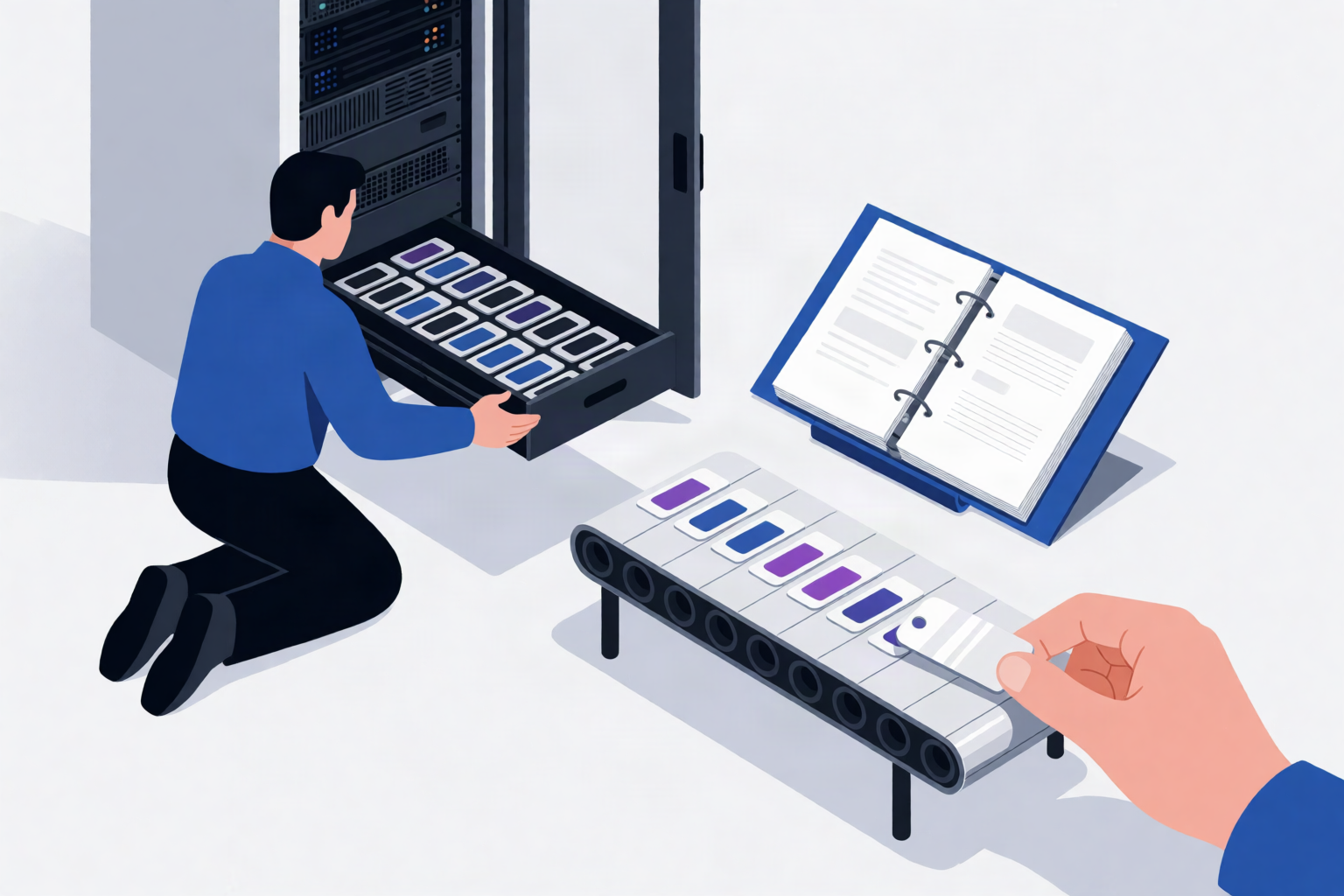
Automated data discovery is the continuous process of scanning data stores, inferring schema and semantics, and writing every field into a catalog mapped to a specific regulatory obligation. Done properly it runs on each deploy, not once a year. The reason it matters is arithmetic: HIPAA's Safe Harbor list names 18 identifier classes at 45 CFR 164.514(b)(2), PCI DSS v4.0 carries 12 requirements, and GDPR Article 30 expects one record per processing activity. You cannot satisfy any of those from a spreadsheet someone updates at quarter end.
Key takeaways
- Discovery, cataloging, and classification are three different jobs. Discovery finds fields; the catalog stores what you found; classification assigns the regulatory label. Most failed programs conflate them.
- Real-time discovery runs on a change feed (CDC, WAL, binlog), not on a nightly full-table scan. Sampling 10,000 rows per changed table is usually enough; scanning everything is usually a budget problem, not an accuracy win.
- Schema inference tells you a column is a 16-digit string. It does not tell you it is a PAN. The last mile is always a rule plus a human sign-off.
- Every discovery tool needs broad read access to your most sensitive stores. That access is itself a compliance surface, and it belongs in your risk analysis.
- The output that survives an audit is not a dashboard. It is a field-level record with a timestamp, a confidence score, and a pointer to the evidence.
What Is Automated Data Discovery and Why Does It Matter for Regulated Data?
Automated data discovery is the programmatic scanning of structured and unstructured stores to find data elements, infer their type and meaning, and record them in a searchable inventory. For regulated data it matters because every obligation — a GDPR Article 30 record, a HIPAA risk analysis, a PCI DSS scoping decision — begins with knowing which column holds what.
Gartner's overview of data discovery frames it as the process of identifying and understanding data across an organization. The Data Governance Institute's resource library treats it as a governance prerequisite rather than a tool category. Both are right, and neither tells you what to do when the column is named fld_3 and holds a national ID number.
That is the actual work. Discovery is easy on a schema someone documented. It is hard on the 400 tables nobody has touched since the last migration.
The practical distinction:
- Discovery answers "where is there data of type X?"
- A catalog answers "who owns it, where did it come from, who can read it?"
- Classification answers "which regulation applies to it, and what does that require?"
You need all three, in that order, and the third one is where the compliance value actually lands.
How Do Real-time Scans and Schema Inference Work?

Real-time discovery has three moving parts: a change feed, an inference pass, and a writer that updates the catalog. The change feed reads CDC streams or WAL/binlog positions; inference samples and profiles the changed rows; the writer upserts a field-level record with a timestamp, a confidence score, and an evidence pointer back to the source.
The three scan modes behave very differently in production.
| Mode | Mechanism | Typical latency | Where it breaks |
|---|---|---|---|
| Full batch scan | Table scan + sampling | Hours to days | Cost on large tables; misses short-lived columns |
| Scheduled incremental | High-water mark on updated_at | Minutes to hours | Breaks on tables without a reliable timestamp |
| Event-driven (CDC) | WAL/binlog/stream consumer | Seconds | Breaks on bulk loads, DDL changes, and schema drift |
I default to event-driven for anything that creates or alters columns, and scheduled incremental for content changes. Full scans are for the first pass and for periodic reconciliation, not for steady state.
Schema inference for compliance: what it can and cannot do
Schema inference for compliance means deriving type, nullability, cardinality, and format from the data itself, then attaching a regulatory label. It works well on typed columns. It works badly on JSONB, VARIANT, and MAP<STRING, STRING> columns where the keys are dynamic — a payload keyed by user ID looks like 50,000 distinct fields and none of them are stable.
Three inference signals carry most of the weight:
- Format matching — Luhn-valid 16-digit strings, IBAN checksums, SSN patterns, NPI checksums.
- Cardinality and uniqueness — a column with 1.0 uniqueness and 9-digit values is an identifier, not a category.
- Co-occurrence —
first_namenext tolast_namenext todobis a record, not three independent fields.
What inference cannot do is decide whether a date of birth is a HIPAA identifier in context. Under Safe Harbor it usually is; under the Expert Determination path at 45 CFR 164.514(a) it depends on re-identification risk. That is a judgment call, and it needs a named owner.
How Do You Map Data Elements to GDPR, HIPAA, and PCI DSS 4.0?

You map by attaching a regulatory label to each discovered field, then deriving the required artifacts from those labels. The label is the join key between your technical inventory and your compliance documentation — get it wrong and every downstream report is wrong too.
| Regime | Scope trigger | Field-level artifact | Concrete example |
|---|---|---|---|
| GDPR | Article 4(1) personal data; Article 9 special categories | Article 30 record + lawful basis tag | patient_email → personal data; diagnosis_code → Article 9 |
| HIPAA | 45 CFR 164.514(b)(2) — 18 identifier classes | ePHI tag + risk analysis entry | mrn, dob, postal_code (ZIP3 only, and only where the prefix covers 20,000+ people) |
| PCI DSS v4.0 | PAN and cardholder data; sensitive authentication data | CDE scoping + data-flow diagram | pan, cardholder_name, expiry; cvv2 is SAD and must not be stored post-authorization |
| CCPA/CPRA | §1798.140(v) personal information; §1798.140(ae) sensitive personal information | Consumer request mapping + inventory | ip_address, precise_geolocation |
| DORA | In force since 17 January 2025 | ICT asset register + dependency map | Contract and system identifiers behind a critical function |
Two things this table hides. First, the same field can carry several labels — a pan in a table with a customer name is both PCI cardholder data and GDPR personal data. Second, the labels drift. A column that was a free-text note last quarter becomes a structured field this quarter. Your inventory needs a review cadence, and if you operate in the US, that cadence has to track state privacy law updates and their enforcement timelines.
For metadata management for regulatory compliance, the rule I use is simple: one label per (field, regime) pair, with an owner and a review date. No owner, no label.
Which Data Discovery Tools and Integration Points Fit a Regulated Stack in 2026?
There are three integration points that matter, and most teams need two of them. Cloud-native scanners (AWS Macie, Google Cloud DLP, Microsoft Purview) sit closest to the storage layer and are cheapest to run. Commercial catalogs add lineage, ownership, and workflow. Open-source catalogs (DataHub, OpenMetadata, Amundsen) give you the metadata model without the licence cost, and the operational cost instead.
| Integration point | What it gives you | Typical latency | Failure mode |
|---|---|---|---|
| Storage-layer scanner | Raw classification at the bucket/table level | Minutes | No lineage, no ownership, weak on nested types |
| CDC/stream consumer | Field-level change events | Seconds | Needs DDL handling; noisy during migrations |
| Query-log analysis | What is actually being read, by whom | Hours | Blind to data never queried |
| CI schema gate | Blocking check on new columns | Build time | Only covers what goes through CI |
For data catalog implementation for PII specifically, the deciding question is not which tool has the best classifier. It is whether the catalog can hold a field-level record with a stable identifier that survives a table rename. If it cannot, your PII inventory rots within two quarters.
I would pick a cloud-native scanner plus an open-source catalog over a single commercial suite, in most cases. The scanner is commoditized; the metadata model is where you will spend your integration effort, and you want it somewhere you can query directly.
What Breaks at Scale? Challenges and Trade-offs in Real-time Discovery
Real-time discovery fails in four predictable ways: cost, false positives, access surface, and drift. The cost is the easiest to see and the least important. The access surface is the one that ends up in your risk analysis.
- Cost. Profiling every row of a multi-terabyte table on every change is not viable. Sample. I use 10,000 rows per changed table as a default and raise it only for tables where the classifier is uncertain.
- False positives. A regex for 16-digit numbers matches order IDs and timestamps. Every false positive costs a human review, and reviewers stop reviewing when the queue is 90% noise.
- Access surface. The scanner needs read access to production. That credential is a target, and it must be scoped, rotated, and logged. If you cannot say who read the
patientstable last Tuesday, you have a finding. - Drift. Schemas change without notice. A column renamed from
ssntotax_idsilently drops out of scope unless your discovery runs on DDL events, not just on data changes.
Data observability for regulated industries is a related but separate discipline — freshness, volume, and distribution checks on the data itself. Discovery tells you what a field is. Observability tells you whether it is still arriving. You need both, and they usually live in different teams. The overlap is real, and I have written separately about the data quality metrics that hold up under audit.
How Do You Verify Discovery Accuracy? Metrics and Audit Trails
You verify discovery with a labelled ground-truth sample and four metrics: precision, recall, coverage, and staleness. Anything else is a dashboard, not a control.
| Metric | Definition | Target I would defend |
|---|---|---|
| Precision | Correct classifications ÷ total classifications | ≥ 0.95 on regulated classes |
| Recall | Regulated fields found ÷ regulated fields present | ≥ 0.98 on PAN, SSN, MRN |
| Coverage | Stores scanned ÷ stores in scope | 100% for the CDE and ePHI systems |
| Staleness | Age of the oldest unreviewed field record | ≤ 30 days |
Build the ground-truth set by hand: pull 200 fields, label them yourself, and re-run the classifier against it each time you change a rule. Precision matters more than recall for review cost; recall matters more for regulatory exposure. If you have to pick, pick recall on PCI and HIPAA classes and precision everywhere else.
The audit trail needs to record who changed a label, when, from what, and why. A label change from pci.cardholder_data to internal is the kind of event an auditor will ask about, and "the classifier did it" is not an answer.
What Comes After Discovery? Data Classification Automation and Policy Enforcement
Discovery is the input. Enforcement is the output, and it is where the money is. Once a field carries a label, that label should drive masking, retention, access policy, and downstream propagation.
Concretely, a pci.cardholder_data label should trigger tokenization at write time and a retention limit measured in months, not years. A hipaa.identifier label should trigger access logging under 45 CFR 164.312(b) and a minimum-necessary access review. A gdpr.special_category label should trigger a DPIA check before the schema ships.
Two things discovery does not do, and I would rather say so plainly:
- It does not delete anything. Enforceable deletion is a separate architecture problem, and I have covered retention policies for regulated data and how to make deletion provable elsewhere.
- It does not prove accuracy. It produces evidence. A human still signs off on the regulated classes.
If you want the classification layer in more depth, automated data classification for regulated data covers the tooling and the labeling workflow.
How Do You Wire Automated Data Discovery Into CI/CD?
You wire discovery into CI by running it against the migration diff, not the whole database. The gate is a schema check: if a migration adds a column that matches a regulated pattern and carries no classification, the build fails.
Here is the shape of the gate I would write:
# illustrative — not a product config
scan:
 source: migration_diff
 sample_rows: 10000
rules:
 - match: { name: ".*_ssn$|^ssn$" }
 classify: [hipaa.identifier, gdpr.personal_data]
 - match: { name: "^pan$|^card_number$" }
 classify: [pci.cardholder_data]
 enforce: { storage: tokenize }
on_unclassified_match: fail # fail | warn | open_ticket
The failure mode you are preventing is a developer adding customer_tax_id on a Friday and nobody noticing until an audit. A blocking check costs one build cycle. A missed column costs a remediation project.
Pair the gate with a post-deploy reconciliation scan so columns created outside CI — by a DBA, by a migration tool, by a data engineer in a notebook — still land in the catalog. And if you are running high-risk AI systems under the EU AI Act, the same pipeline is where you capture the Article 10 data governance evidence; the mechanics are in this guide to data lineage for AI Act Article 10 audit trails.
If you want to see what the output looks like on your own schema, map a sample file or schema against AdaptivMapr and read the field-level records it produces. That is the fastest way to find out whether your current inventory is accurate or merely present.
FAQ
What is automated data discovery for regulated data?
It is the continuous, programmatic scanning of data stores to locate fields, infer their type and meaning, and record each one in a catalog with a regulatory label attached. The label is what connects a technical field like patient_mrn to a specific obligation, such as a HIPAA risk analysis entry or a GDPR Article 30 record.
What is the difference between data discovery and data classification?
Discovery finds and describes fields. Classification assigns the regulatory meaning — pci.cardholder_data, hipaa.identifier, gdpr.special_category. You can run discovery without classification and get a useful inventory, but you cannot run classification without discovery, because there is nothing to label.
How accurate is schema inference for compliance?
It depends on the data type. Typed columns with stable formats — PANs, IBANs, NPIs, SSNs — classify well because the formats carry checksums. Free-text, JSONB, and dynamically keyed columns classify poorly. I would not run a regulated program without a labelled ground-truth sample and a precision/recall target you can defend.
Does real-time discovery need to scan every row?
No, and you should not try. Sampling 10,000 rows per changed table is enough for most classifiers, and it keeps the cost bounded. Scan everything on the initial pass and on periodic reconciliation, then switch to change-driven sampling.
What does automated data discovery not do?
It does not delete data, enforce retention, or prove accuracy. It produces field-level evidence that a human still has to review for regulated classes. Deletion, masking, and access enforcement are separate controls that consume the labels discovery produces.